
Most salon owners think seasonal promotions mean slashing prices and hoping clients show up. That framing costs you money and trains clients to wait for discounts instead of booking at full price. Understanding how seasonal promotions work in salons means something entirely different: aligning your service offerings with what clients actually want at specific times of year, filling slow weeks with purpose, and increasing what each visit is worth. This guide breaks down the mechanics, the timing, the design, and the measurement so you can run promotions that build revenue instead of eroding it.
Table of Contents
- Key Takeaways
- How seasonal promotions work in salons
- Strategic planning and timing
- Designing promotions that boost average ticket
- Promoting seasonal offers through digital channels
- Measuring success and improving over time
- My honest take on seasonal promotions
- Run smarter seasonal promotions with Say-salon
- FAQ
Key Takeaways
| Point | Details |
|---|---|
| Promotions are not just discounts | Effective seasonal offers bundle services and add-ons to raise average ticket value, not lower prices. |
| Plan at least one month ahead | Early preparation lets you align marketing materials, staff training, and scheduling before demand peaks. |
| Segment your client list | Targeted messages based on service history outperform generic blasts and drive higher rebooking rates. |
| Track attach rates and revenue | Monitoring which add-ons clients accept tells you what promotions are actually working. |
| Avoid over-discounting | Clients who only book during sales hurt your margins. Build perceived value instead. |
How seasonal promotions work in salons
Seasonal promotions in a salon context are structured offers tied to predictable shifts in client demand throughout the year. They are not random sales events. They are a planned response to what clients need before prom night, holiday parties, back-to-school season, or summer weddings.
The core mechanics work like this: you identify a window when client demand spikes or dips, then you create an offer that either captures that peak demand or incentivizes bookings during a slow stretch. Both goals require different approaches. A peak-season promotion might bundle a blowout with a scalp treatment to increase the value of an already-booked appointment. A slow-period promotion might offer a "January refresh" package to pull clients back in after the holiday rush ends.
Here is what makes seasonal promotions genuinely effective in salons:
- Demand alignment. Calendar-tied promotions like Spring Color Refresh or Holiday Glam packages succeed because they match what clients are already thinking about.
- Service bundling. Pairing a core service with a complementary add-on raises the average ticket without requiring the client to make a separate decision.
- New client acquisition. A well-timed seasonal offer gives a first-time visitor a reason to choose your salon over a competitor.
- Retention during slow periods. Filling gaps in your schedule with targeted offers keeps revenue steady year-round.
- Gift card pushes. Holiday gift card promotions convert existing clients into referral sources.
Pro Tip: Think of seasonal promotions as a product launch, not a clearance sale. You are introducing a limited-time experience, not liquidating unsold inventory.
The most common mistake is treating every promotion the same way. A summer highlight package and a Valentine's Day couples deal serve completely different client motivations. Knowing the difference is where effective salon marketing methods begin.
Strategic planning and timing
The single biggest reason seasonal promotions underperform is late execution. Planning promotions at least one month ahead gives you time to prepare marketing materials, brief your team, and update your booking system before demand arrives. Launching a Mother's Day special the week of Mother's Day means you missed the window when clients were actually making plans.
A promotional calendar is your most practical planning tool. Map it out at the start of each quarter and include the following:
- Anchor dates. Prom season, holidays, back-to-school, Valentine's Day, and summer wedding season are your highest-leverage windows.
- Slow periods. January, early September, and post-holiday February are typically soft months in most markets. These need their own offers.
- Lead time for each promotion. Work backward from the launch date to set deadlines for graphics, staff briefings, and email scheduling.
- Signage updates. Reusable modular signage lets you swap out seasonal messaging without paying for a full redesign every time, keeping your salon looking polished without the cost.
Pro Tip: Build a simple shared calendar with your team that shows every promotion, its launch date, and who owns each task. It takes 30 minutes to set up and saves hours of last-minute scramble.
Here is a quick comparison of reactive versus planned promotion approaches:
| Approach | Lead time | Typical outcome |
|---|---|---|
| Reactive (last-minute) | Less than 1 week | Low client awareness, poor booking lift |
| Planned (1 month ahead) | 4 to 6 weeks | Higher visibility, staff prepared, better results |
| Strategic (quarterly calendar) | 3 months ahead | Consistent revenue, measurable improvement |
Staff training is part of this timeline too. Your team needs to know what the promotion is, how to describe it naturally at checkout, and how to handle questions. A promotion your stylists cannot explain confidently will not convert.

Designing promotions that boost average ticket
The best seasonal promotion ideas are built around adding value, not subtracting price. Over-discounting trains clients to wait for sales, which compresses your margins on the very clients who book most often. The smarter path is bundling.
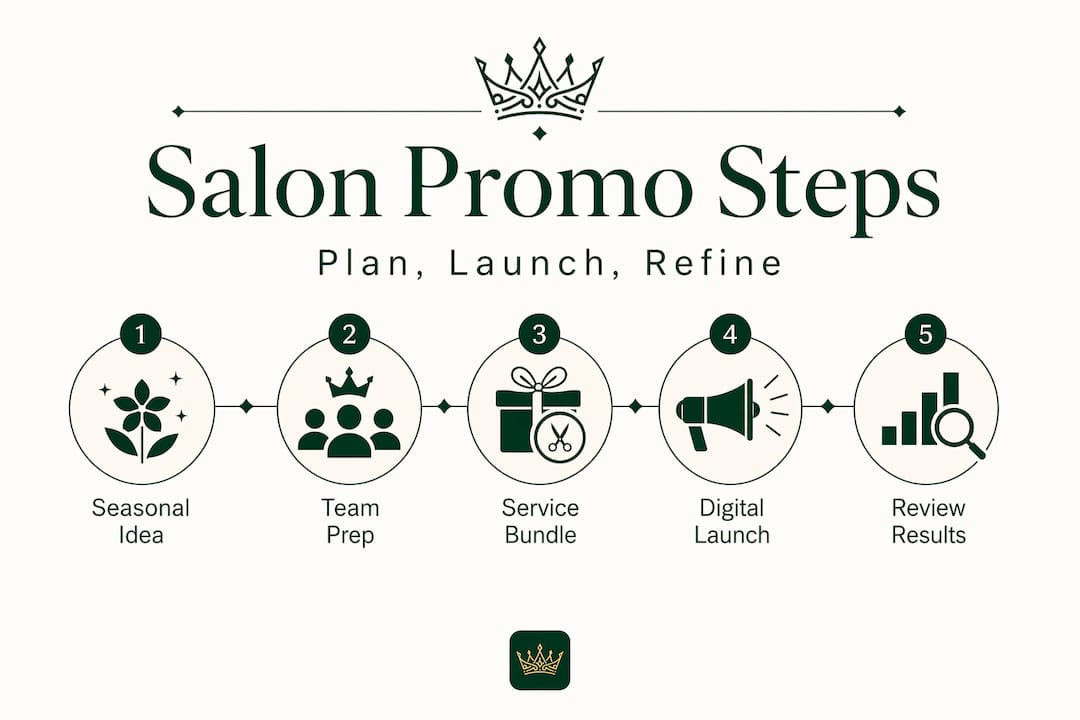
Here is a step-by-step approach to building a high-performing seasonal bundle:
- Start with a core service. Pick something clients already book regularly, like a haircut, color service, or blowout.
- Add a quick express service. Express add-ons take only 10 to 15 minutes and require minimal extra setup. Scalp massages, gloss treatments, deep conditioning, and brow shaping all fit this model.
- Price for perceived value. Set the bundle price so the client feels they are getting more, not paying less. A $95 bundle that includes a $75 cut and a $30 gloss treatment feels like a deal without discounting the core service.
- Name it seasonally. "Summer Shine Package" or "Holiday Glam Bundle" creates context and urgency that generic pricing does not.
- Limit availability. Positioning it as a seasonal or limited-time offer increases booking intent.
For nail services, exploring popular nail salon services can help you identify fast add-ons that fit naturally into seasonal bundles without extending appointment times significantly.
Here is how different bundle structures compare on revenue impact:
| Bundle type | Time added | Average ticket lift | Client perception |
|---|---|---|---|
| Core service only | None | Baseline | Standard |
| Core + express add-on | 10 to 15 minutes | 15 to 30% | High value |
| Core + retail product | None | 10 to 20% | Moderate value |
| Full seasonal package | 20 to 30 minutes | 25 to 40% | Premium experience |
Pro Tip: Track your attach rate, meaning the percentage of clients who accept the add-on when offered. If it is below 20%, the issue is usually how the offer is being presented, not the offer itself.
Tracking attach rates alongside revenue per visit gives you a clear picture of which promotions are actually moving the needle and which ones just feel busy.
Promoting seasonal offers through digital channels
You can design the perfect seasonal package and still fill zero extra appointments if clients do not hear about it. Digital promotion is where most salons leave money on the table, not because they are not posting, but because they are broadcasting instead of targeting.
Segmented email campaigns that match offers to client service history consistently outperform generic blasts. A client who gets highlights every eight weeks should receive your Spring Color Refresh offer. A client who only books cuts does not need that email. Sending the right offer to the right person is what drives bookings.
Your digital promotion toolkit for seasonal campaigns should include:
- Automated welcome series. New clients get a sequence that introduces your seasonal offers and makes rebooking easy.
- Post-visit follow-ups. A thank-you message sent 24 hours after a visit with a relevant seasonal offer converts at a high rate because the experience is still fresh.
- Monthly newsletters. Use these to preview upcoming seasonal packages before they launch, building anticipation.
- SMS notifications. Short, personalized texts work well for time-sensitive offers like "Book your holiday glam appointment before slots fill up."
- Loyalty program integration. Personalized loyalty rewards are now a client expectation, not a bonus. Reward points tied to seasonal bookings increase repeat visits.
For visual inspiration on seasonal trends your clients are already searching for, resources like seasonal nail art trends can help you align your social content with what clients are actively interested in.
Pro Tip: Set up your seasonal email campaigns to send at least two weeks before the promotion launches. A preview email followed by a launch email followed by a "last chance" reminder is the most reliable sequence for driving bookings.
Measuring success and improving over time
Running a seasonal promotion without measuring it is like doing a color service without a before photo. You have no way to know if anything changed.
The KPIs that matter most for salon seasonal promotions are:
- Average ticket increase. Did clients spend more per visit during the promotion period compared to the same period last year?
- Attach rate. What percentage of clients accepted the add-on or bundle offer?
- Rebook rate. Did promotion clients rebook at a higher rate than non-promotion clients?
- New client acquisition. How many first-time visitors came in specifically because of the seasonal offer?
- Promo code usage. If you used a code, track redemption rates by channel to see where your promotion actually reached people.
Common pitfalls to watch for: unclear offer language that confuses clients, promotions that run too long and lose urgency, and poor follow-up after the promotion ends. A client who came in for your holiday package in December is a strong candidate for your January refresh offer. If you do not follow up, you are leaving a warm lead cold.
Pro Tip: Compare each seasonal promotion to the same window from the prior year, not just to the previous month. Seasonality creates natural revenue swings, and month-over-month comparisons will mislead you.
Use scheduling data and client feedback to refine your timing each cycle. If your prom season promotion always books out in the first week, launch it earlier next year. If your January offer underperforms, test a different bundle structure or a different incentive.
My honest take on seasonal promotions
I have seen salons run the same 20% off promotion every season for years and wonder why it stops working. The truth is that discounts create a ceiling on your revenue, not a floor. Every time you train a client to expect a lower price, you make it harder to charge full rate.
What actually works, in my experience, is building promotions around experience and timing rather than price reduction. A client who books your "Holiday Glam Bundle" is not thinking about the discount. They are thinking about how they will look at their company party. That emotional context is what drives the booking, and it is what makes them rebook.
The salons I have seen grow consistently through seasonal marketing are the ones that treat promotions as a system, not an event. They plan ahead, they track results, they adjust, and they repeat. The refinements compound over time. A 5% improvement in attach rate each season adds up to real revenue by year's end.
Digital tools make this much easier than it used to be. When your booking system, client data, and communication tools are connected, you can see exactly which promotions drove which results and act on that information before the next season arrives. The salons that are winning right now are the ones using their data, not just their instincts.
— Say-Salon
Run smarter seasonal promotions with Say-salon
Say-salon's operating system is built for exactly this kind of work. With Say-OS, you can plan and schedule seasonal promotions, segment your client list by service history, and automate your follow-up communications so nothing falls through the cracks. The platform's voice-first interface means your team can update booking notes and client preferences without stepping away from the chair.
Every client gets a free Beauty Passport that tracks their service history, making it easy to send the right seasonal offer to the right person at the right time. If you want to stop guessing which promotions are working and start building a system that improves every season, start free at Say-salon and see what your data can tell you.
FAQ
What are salon promotions exactly?
Salon promotions are structured, time-limited offers designed to drive bookings, increase average ticket value, or attract new clients. They include bundles, add-on packages, gift card deals, and loyalty rewards tied to specific seasons or events.
How far in advance should salons plan seasonal promotions?
Planning at least one month ahead gives you time to prepare marketing materials, train staff, and schedule client communications before demand peaks. Quarterly planning is even more effective.
How do you avoid over-discounting in salon promotions?
Focus on bundling add-on services rather than reducing the price of core services. Bundling profitable add-ons raises average ticket value without conditioning clients to expect lower prices.
What digital channels work best for promoting seasonal salon offers?
Segmented email campaigns, SMS notifications, and loyalty app messages consistently outperform generic social posts. Personalized loyalty rewards tied to seasonal bookings are now a client expectation in 2026.
How do you measure whether a seasonal promotion worked?
Track average ticket increase, add-on attach rate, rebook rate, and new client acquisition during the promotion window. Compare results to the same period from the prior year for an accurate read on performance.