
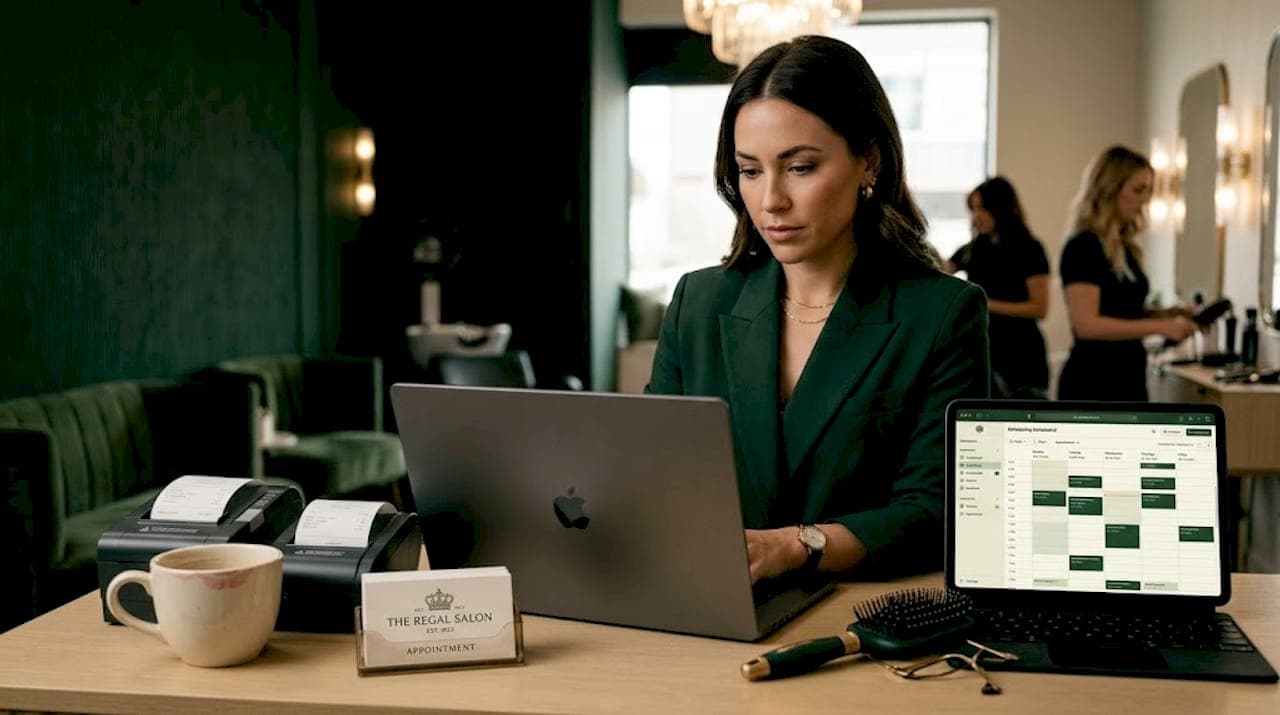
Running a salon without the right systems costs you money every single day. No-shows drain revenue, scheduling conflicts frustrate clients, and manual tasks eat hours you could spend growing your business. When you use AI tools for salon management, you stop reacting to problems and start preventing them. This guide covers exactly how to set up AI scheduling, automate client communication, manage inventory smarter, and protect revenue with technology that actually works in a real salon environment.
Table of Contents
- Key takeaways
- How to use AI tools for salon management: what you need first
- AI scheduling and reminders that actually reduce no-shows
- AI client management and communication that builds loyalty
- AI for inventory, billing, and analytics
- Common challenges when implementing AI tools
- My honest take on AI in salons
- Run your salon smarter with Say-salon
- FAQ
Key takeaways
| Point | Details |
|---|---|
| AI cuts no-shows dramatically | Combining automated reminders, deposits, and waitlists reduces no-shows by up to 80%, recovering thousands in lost revenue. |
| Clean data powers AI results | Accurate service durations, staff availability, and client histories are non-negotiable for AI tools to work without conflicts. |
| AI concierges work around the clock | AI-powered front desks handle bookings, calls, and rescheduling 24/7 so you never miss a paying client. |
| Integrated tools beat isolated features | AI is most effective when scheduling, client management, billing, and analytics connect to one another in a single system. |
| Cost efficiency is real | AI receptionist plans starting at $24.95/month replace the need for a full-time front desk at a fraction of the cost. |
How to use AI tools for salon management: what you need first
Before any AI tool delivers results, your operational foundation has to be solid. Think of it like GPS navigation. The technology is smart, but if you give it a wrong starting address, you end up in the wrong place.
The first thing to get right is your service data. Every service you offer needs an accurate duration, a defined processing time if applicable (like color development), and a setup or cleaning buffer. AI front-desk booking requires accurate service durations and current staff availability to function without double bookings or conflicts. If your balayage service is listed as 60 minutes when it actually takes 150, the AI will create scheduling chaos.
Here is a comparison of popular AI salon management platforms and their core features to help you evaluate your options:
| Platform | Scheduling AI | Client CRM | Inventory | AI Communication |
|---|---|---|---|---|
| Say-salon (SAY-OS) | Yes, voice-first | Yes, Beauty Passport | Integrated | Yes, AI assistant |
| Fresha | Yes, intelligent scheduling | Yes | Limited | Yes, AI Concierge |
| Codeison | Yes | Yes | Yes, smart tracking | Limited |
| Generic booking tools | Basic | Basic | No | No |
Beyond data accuracy, you need a platform that connects your booking calendar, client records, and communication in one place. Disconnected tools create gaps. The role of AI in salon operations is to close those gaps automatically, not to add another app to your stack.
- Audit your service menu and confirm accurate durations for every offering
- Set up staff profiles with real availability, skills, and resource assignments
- Import or organize existing client data including visit history and preferences
- Choose a platform with native AI scheduling and CRM, not bolt-on add-ons
Pro Tip: Before going live with any AI scheduling tool, run a two-week parallel test. Keep your manual calendar alongside the AI system and compare results. This catches configuration errors before they reach clients.
AI scheduling and reminders that actually reduce no-shows
No-shows are the single most expensive problem most salons face. A client who books a two-hour color appointment and simply does not show up costs you the service revenue, the stylist's time, and the slot you could have filled. Automated scheduling with reminders, deposits, and waitlists cuts no-shows by up to 80%, recovering tens of thousands in lost revenue annually for busy salons.
Here is how to set this up correctly:
-
Configure intelligent scheduling with buffers. Set processing times for services that require hands-off waiting (color, perms, treatments). Add setup and cleaning buffers between appointments. Configuring processing time and setup buffers is critical for AI to improve utilization without creating downstream scheduling problems for your team.
-
Build a multi-touch reminder sequence. A single reminder the day before is not enough. Set up a sequence: confirmation at booking, a reminder 72 hours out, another 24 hours out, and a final one two hours before the appointment. Each message should include a rescheduling link so clients can move their appointment without calling.
-
Require deposits for high-value or repeat no-show clients. Most AI platforms let you set deposit rules by service type or client history. A 25 to 50 percent deposit creates real commitment. Clients who pay upfront show up.
-
Activate waitlist and dynamic rebooking. When a cancellation comes in, your AI should immediately notify waitlisted clients and offer the slot. This turns a cancellation into a filled appointment automatically, without your staff lifting a finger.
-
Track your metrics. After 30 days, review your no-show rate, cancellation rate, and waitlist conversion rate. Most salons see measurable improvement within the first month.
| Metric | Before AI | After AI (typical) |
|---|---|---|
| No-show rate | 15-25% | 5-8% |
| Cancellation fill rate | 20-30% | 60-80% |
| Reminder response rate | N/A | 40-60% |
Pro Tip: Assign stylist-specific booking links when possible. Clients who book with a specific person they trust cancel far less often than those who book a generic slot.
AI client management and communication that builds loyalty
Client retention is where the real money is. Acquiring a new client costs five times more than keeping an existing one. The benefits of AI in salons extend well beyond scheduling. They reach into how you communicate, remember, and serve every person who walks through your door.

AI concierge tools change the front desk entirely. Fresha's AI Concierge handles calls and messaging with real-time awareness of your services, pricing, team availability, and individual client history. A client who calls at 9 PM to reschedule gets an immediate, accurate response without your front desk staff working overtime.
AI receptionists answer 35 to 40 percent of calls missed during peak hours and provide 24/7 booking coverage. For most salons, peak call volume hits exactly when your team is busiest with clients. Those missed calls are missed revenue. An AI system captures every one of them.
Here is what strong AI client management looks like in practice:
- Personalized service recommendations. When a client books a trim, the AI notes it has been 14 weeks since their last visit and flags a conditioning treatment based on their history. That is an upsell your staff did not have to think about.
- At-risk client identification. Some AI tools identify at-risk clients based on visit frequency patterns and trigger targeted outreach before a regular client quietly drifts away.
- Multi-language support. AI receptionists with bilingual capability serve diverse client bases without hiring additional staff.
- Unified communication. Bookings, payment confirmations, follow-up messages, and review requests all flow through one system rather than three separate apps.
Pro Tip: Set up an automated post-visit message that goes out 48 hours after each appointment. Ask one simple question: "How did everything go?" Clients who feel heard come back. And the ones who had a problem give you a chance to fix it before they leave a public review.
AI for inventory, billing, and analytics
This is where how to manage a salon with AI gets genuinely interesting. Most salon owners think about AI for scheduling first. But the operational and financial benefits of connecting AI to your inventory and billing are just as significant.
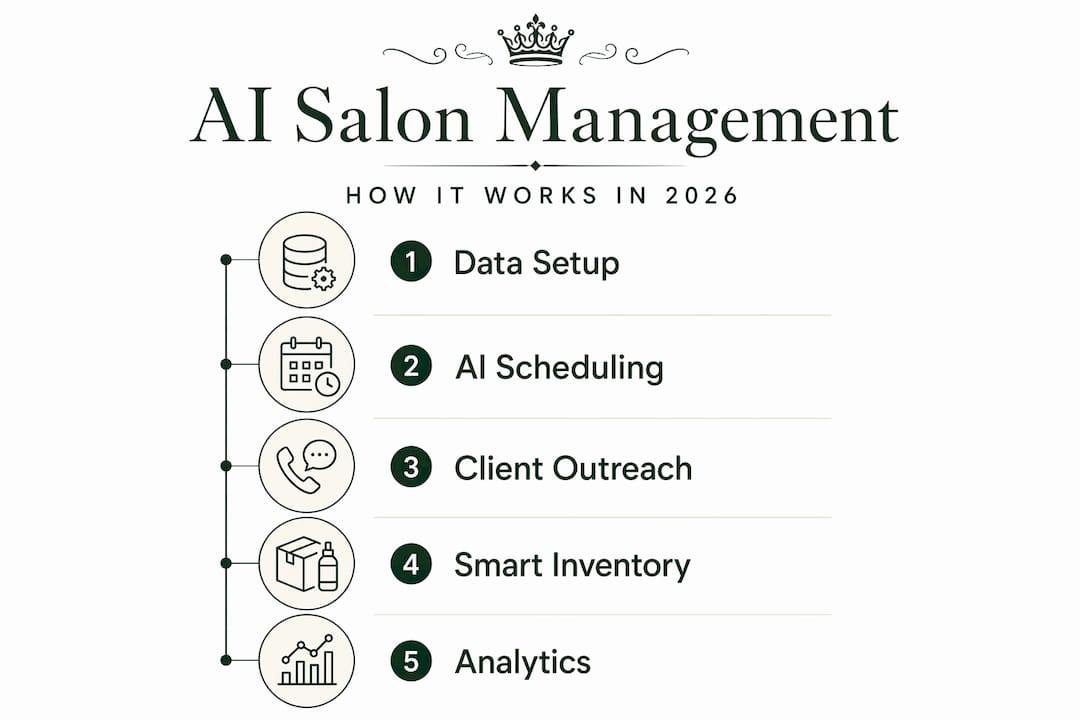
Codeison's AI salon management software includes smart inventory tracking, demand forecasting, and automated invoicing as core features. When your AI system knows how many color treatments you performed last month and what products those services consumed, it can predict when you will run low and trigger a reorder before you run out mid-service.
The practical benefits stack up quickly:
- Automated reorder alerts prevent the "we're out of toner" emergency that disrupts a full day of color appointments.
- AI dashboards surface real-time KPIs: revenue per chair, average ticket size, busiest booking windows, and top-performing services.
- Automated invoicing generates and sends client invoices without manual entry, reducing billing errors and speeding up payment collection.
- Demand forecasting helps you price strategically. If your Saturday afternoon slots fill up three weeks in advance, your AI data tells you that demand supports a premium price for those slots.
AI connecting client management, inventory, and billing to predictive analytics enables proactive decision making rather than reactive scrambling. That shift from reactive to proactive is what separates salons that grow from salons that just survive.
Common challenges when implementing AI tools
Even the best AI salon management software fails when the setup is wrong. Here are the pitfalls to watch for and how to avoid them:
- Inaccurate service data. If your service durations are wrong, your AI schedule will be wrong. Audit every service before you go live.
- Misconfigured resource assignments. If your AI does not know that the single shampoo bowl is a shared resource, it will double-book it. Map every physical resource in your system.
- Evaluating tools in isolation. A scheduling tool that does not talk to your CRM is only half useful. Evaluate AI solutions for the beauty industry as integrated systems, not individual features.
- Skipping staff training. Your team needs to trust the AI. If stylists override the system constantly because they do not understand how it works, you lose all the efficiency gains.
- Choosing tools you will outgrow. Pick a platform that scales. A tool that works for a two-chair suite should also work when you expand to ten chairs.
Pro Tip: Assign one team member as your AI system owner. This person handles configuration updates, monitors performance metrics, and serves as the internal expert. Without clear ownership, AI tools drift and degrade over time.
My honest take on AI in salons
I've watched salon owners get excited about AI and then quietly stop using it six months later. In almost every case, the problem was not the technology. It was that they treated AI like a plug-and-play appliance instead of a system that needs accurate data and thoughtful configuration to deliver results.
What I've learned from working in this space is that the salons getting real results from AI are the ones who did the boring work first. They cleaned up their service menu. They mapped their staff schedules accurately. They committed to one platform instead of four.
The other thing I've seen people get wrong is expecting AI to replace the human touch entirely. That is not the goal. The goal is to free your team from answering the same booking questions 30 times a day so they can focus on the client sitting in the chair. Capturing missed inbound leads 24/7 and converting existing clients through timely reminders are the fastest routes to revenue gains. But the experience that keeps clients loyal still comes from your people.
The future of AI in the beauty industry is not about replacing stylists. It is about giving them back the time and headspace to do what they do best.
— Say-Salon
Run your salon smarter with Say-salon
If you are ready to put these ideas into practice, Say-salon's SAY-OS platform was built specifically for salon owners who want AI that works with their real operations. SAY-OS brings together voice-first booking, intelligent scheduling, client memory through the free Beauty Passport, and an AI assistant that handles communication so your team does not have to.
Fresha is trusted by more than 140,000 beauty and wellness businesses worldwide, which tells you the market for AI salon tools is real and growing fast. Say-salon takes that same ambition and builds it around a voice-first experience designed for how salons actually operate. Start free and see what your salon looks like when the technology finally works for you, not against you. Try SAY-OS free and get your first look at AI-powered salon management done right.
FAQ
What are the best AI tools for salon management?
The best AI salon management tools combine scheduling, client CRM, communication, and analytics in one system. Platforms like Say-salon's SAY-OS, Fresha, and Codeison offer integrated AI features that cover booking, reminders, inventory, and billing.
How much can AI reduce no-shows in a salon?
Automated scheduling with multi-touch reminders, deposits, and waitlist management reduces no-shows by up to 80%, recovering significant lost revenue for salons that implement the full system correctly.
Do I need technical skills to use AI salon management software?
No. Most modern AI salon platforms are designed for non-technical users. The key requirement is accurate operational data: correct service durations, staff availability, and client records. The AI handles the rest once your data is clean.
How does AI help with client retention in salons?
AI tools track visit frequency, identify at-risk clients, and trigger personalized outreach before regulars drift away. Combined with post-visit follow-ups and service recommendations based on history, AI keeps clients engaged between appointments.
What does AI salon management software typically cost?
Costs vary widely by platform and features. AI receptionist tools start as low as $24.95 per month, while full AI salon operating systems like SAY-OS offer free entry-level access with paid tiers as your needs grow.