
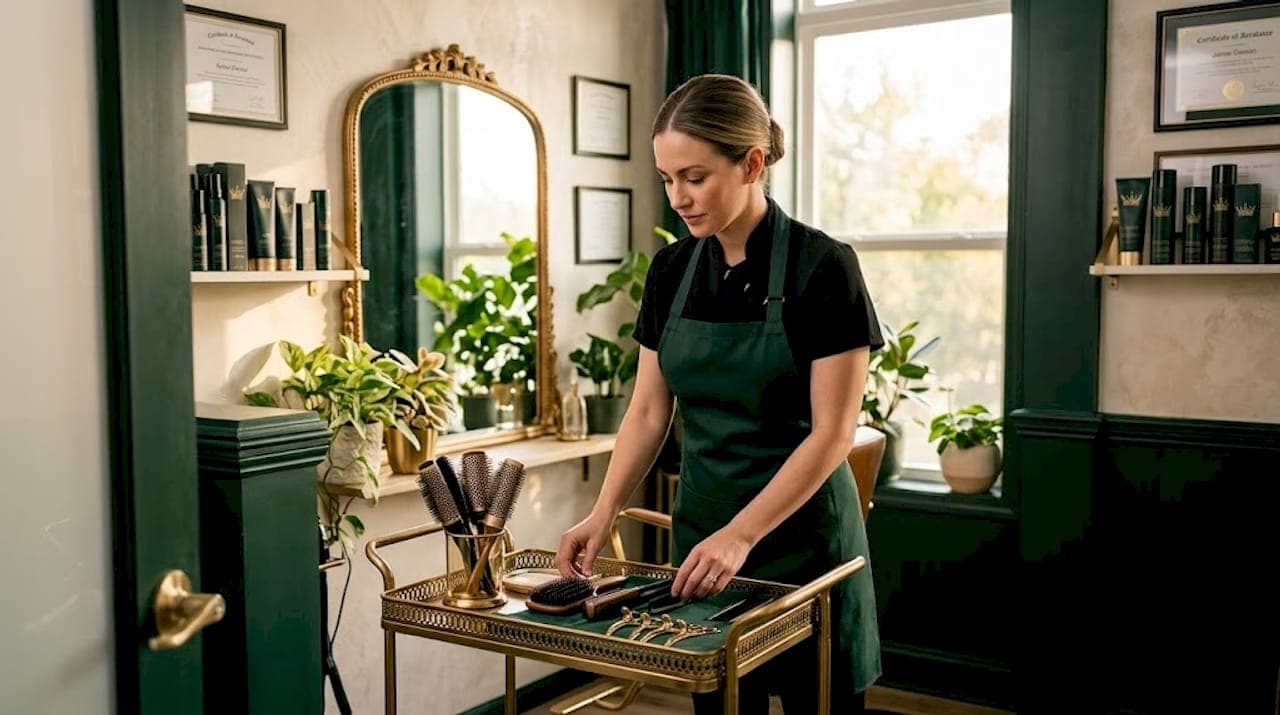
The salon suite model is reshaping how beauty professionals work, earn, and build careers. Instead of clocking in under someone else's brand and handing over half your revenue in commission splits, you rent a private space, set your own prices, and keep what you make. Understanding why salon suite model is growing requires looking at both the numbers and the ground-level realities driving stylists, estheticians, and nail techs to make the leap. This isn't a niche trend. It's a structural shift that's already rewritten the business of beauty.
Table of Contents
- Key takeaways
- Why salon suite model is growing: market scale and history
- The financial case for going independent
- Lifestyle and professional autonomy
- Operational realities you need to understand
- How franchise ecosystems reduce risk
- My take on why this shift is permanent
- Run your suite smarter with Say-salon
- FAQ
Key takeaways
| Point | Details |
|---|---|
| Market growth is significant | The salon suite industry hit $3.1 billion by 2022, growing at 10.5% annually since 2017. |
| Financial upside is real | Switching to suites can increase take-home pay by 25 to 35% in the first year alone. |
| Lifestyle drives the decision | 70% of stylists leaving traditional salons cite flexible hours and reduced workplace friction as top reasons. |
| Operations require discipline | Profitable suite operators track finances weekly and price at or above market rates to stay solvent. |
| Franchise ecosystems reduce risk | Platforms like Sola Salons provide education, technology, and community to support independent tenants. |
Why salon suite model is growing: market scale and history
The numbers make the case fast. The salon suite industry grew at 10.5% annually between 2017 and 2022, reaching a market size of $3.1 billion. That growth didn't happen in a vacuum. It tracked directly with a broader shift in how beauty professionals think about ownership, income, and client relationships.
What accelerated that growth? Two metrics stand out. Suite clients show an 82% retention rate, significantly higher than traditional salon averages. Appointment blocks in suite settings also run about 10 minutes longer, because the one-on-one environment naturally produces a more relaxed, personalized experience. Clients stay longer, tip better, and come back more consistently.
"Money is redistributing from salon payrolls to independent businesses and from commission splits to flat rents. The salon suite model isn't a workaround. It's where the industry is heading." — Lutily Blog
Meanwhile, the professional beauty services market itself is on a steep trajectory. Market projections show growth from $247.6 billion in 2026 to $432.62 billion by 2034, driven largely by independent operators rather than traditional corporate chains. The salon suite business model is capturing a large portion of that growth.
| Year | Market Indicator | Key Metric |
|---|---|---|
| 2017 | Salon suite industry baseline | Growth trend begins at scale |
| 2022 | Market reaches $3.1 billion | 10.5% annual growth rate confirmed |
| 2026 | Beauty services market at $247.6B | Independent operators lead expansion |
| 2034 | Beauty services projected at $432.62B | 7.22% CAGR, suites positioned centrally |
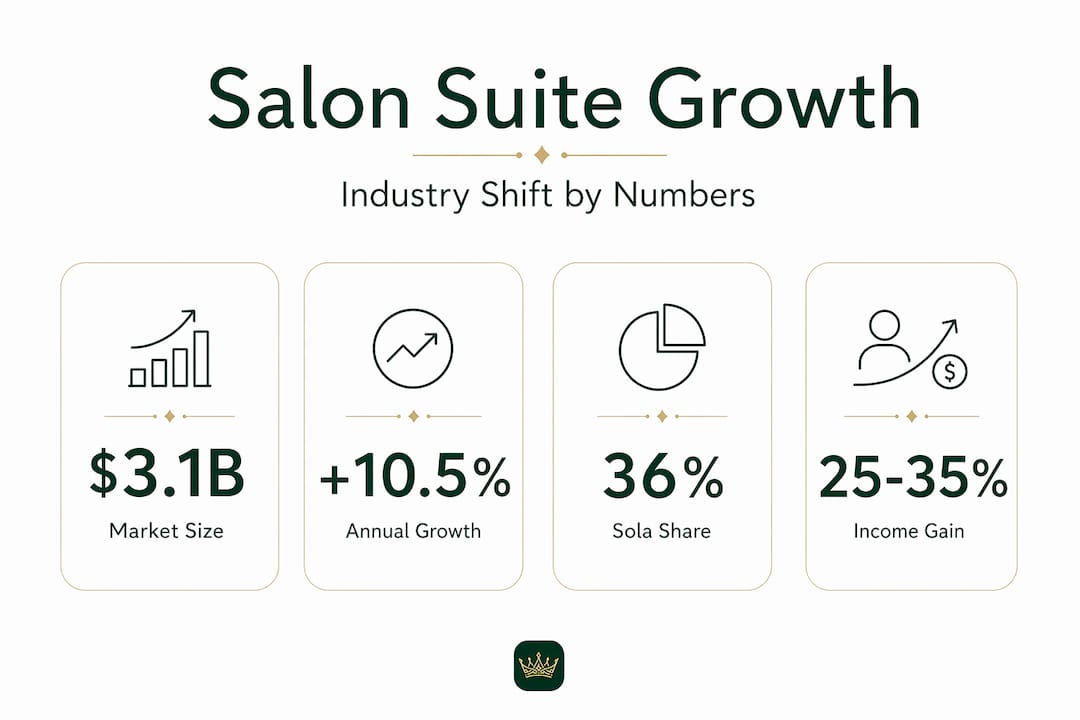
The emergence of major franchisors has also accelerated legitimacy. Sola Salons holds approximately 36% of the salon suite market share, with over 750 locations and 21,000 independent tenants. When one company can scale that quickly in a single vertical, it signals that demand is real and sustained, not speculative.
The financial case for going independent
Here's where many beauty professionals have their "aha" moment. In a commission-based salon, you're typically working on a 40 to 60% split. That means if you generate $1,000 in a week, you're taking home $400 to $600 before expenses. With a salon suite, you pay a flat rent, usually between $400 and $1,200 monthly, and keep everything else.

The math adds up fast. Beauty professionals switching to the suite model report a 25 to 35% increase in take-home pay within the first year. That's not because they're working more hours. It's because they're retaining a far larger share of what they already earn.
What makes a suite profitable
| Factor | Commission Salon | Salon Suite |
|---|---|---|
| Revenue split | 40 to 60% kept by stylist | 100% kept after flat rent |
| Retail sales | Usually shared with salon | 100% kept by professional |
| Pricing control | Set by salon management | Set by the professional |
| Schedule control | Owner-determined | Fully flexible |
The most profitable suite stylists maintain average service tickets of $85+ and serve 28 to 35 clients weekly. Underpricing is the single most common reason suite professionals struggle financially, not low client volume. If you're charging less than market rates because you fear losing clients, you're working harder for the same or worse outcome.
A sound financial rule: rent should not exceed 15% of gross revenue. If your suite costs $800 per month, you need to generate at least $5,333 monthly in services and retail to keep your margins healthy. Retail sales inside the suite matter here. Every product you sell adds profit without adding a single appointment to your calendar.
Pro Tip: Before signing a lease, calculate your breakeven point using your current client volume and average ticket. If you're seeing 25 clients weekly at $75 average, that's roughly $7,500 monthly before retail. Most suite rents will leave significant room for profit at that volume.
Lifestyle and professional autonomy
Financial gains alone don't explain the growing popularity of salon suites. The lifestyle argument is just as powerful. A full 70% of stylists leaving traditional salons cite flexible hours and reduced workplace drama as primary motivations. That's a telling statistic. It says the traditional salon model isn't just financially inefficient for many professionals. It's personally unsustainable.
The advantages of salon suite ownership on this front are real and specific:
- Creative control. You choose your color lines, retail brands, service menu, and aesthetic. Nobody overrides your professional judgment.
- Scheduling freedom. You work the hours that suit your life, whether that means four long days or six shorter ones.
- Client experience design. From the music playing to the lighting to the consultation process, you define every touchpoint.
- Reduced conflict. The interpersonal friction that plagues open-floor salons essentially disappears when you're the sole operator of your space.
- Brand building. Your suite becomes your brand. Clients aren't loyal to the salon. They're loyal to you, and your space reinforces that identity.
The industry's turnover problem underscores how badly professionals have wanted this shift. Traditional salon turnover rates run around 40%, costing owners approximately $5,000 per departing stylist. That churn isn't random. It reflects professionals who wanted more control and eventually went to find it.
Pro Tip: When you transition to a suite, bring your top 30 clients with a personal message rather than a generic announcement. Research consistently shows clients follow their stylist, not the salon. A personal note converts significantly better than a social media post.
Operational realities you need to understand
The benefits of salon suites are real. So are the responsibilities. This is where some professionals get caught off guard, and where the salon suite vs traditional salons comparison gets more nuanced.
When you rent a suite, you are running a business. That means:
- Booking management. You handle your own scheduling, cancellation policies, and no-show fees. No front desk to blame.
- Marketing. Your clients won't find you unless you show up consistently on social media, Google, and booking platforms. Passive visibility doesn't exist for solo operators.
- Supplies and inventory. You purchase your own products and track what you use. Unmanaged supply costs eat margins faster than most professionals expect.
- Insurance. You need professional liability insurance and renter's insurance, independent of any coverage the suite facility carries.
- Financial tracking. Experts recommend weekly financial tracking to stay on top of revenue, expenses, and profitability trends. Monthly reviews catch problems too late.
The professionals who struggle in suites typically underestimate three things: how long client acquisition takes when starting fresh, how much time marketing requires, and how easy it is to absorb expenses into daily costs without noticing them accumulating.
Pre-booking policies are one of the most underused retention tools in suite settings. If 80% of your clients book their next appointment before they leave, your schedule stays full without constant outreach. Signature services matter too. When you're known for something specific, referrals come naturally because clients can describe exactly what you do.
For booking tool options, checking salon booking alternatives can help you find software that fits your volume, pricing needs, and client communication style.
How franchise ecosystems reduce risk
Not every salon suite professional starts from scratch. Major franchise platforms have built ecosystems specifically designed to reduce the startup friction that stops capable professionals from making the move.
Sola Salons provides tenants with education programs, technology tools, health benefit access, and a built-in community. That's a meaningful value proposition for someone who has never operated as an independent business before.
Suite arrangements through established operators typically also include:
- Utilities and Wi-Fi covered in lease payments, creating a predictable monthly expense model
- Building maintenance and common area upkeep handled by the operator
- Marketing support and directory listings that surface your suite to local clients
- Community events and professional development programming within the suite facility
Choosing an established platform doesn't mean giving up independence. It means you're getting infrastructure support while retaining full control over your pricing, services, schedule, and client relationships. For many beauty professionals making the transition, that combination is exactly what makes the move feel manageable rather than overwhelming.
My take on why this shift is permanent
I've watched the beauty industry cycle through trends for years. Most of them fade. The salon suite movement is not going to fade. What I've seen, again and again, is that the conditions driving it aren't temporary. Economic pressure on commission-based income, the demand for personal brand building, and the expectation of schedule flexibility aren't trends. They're permanent shifts in how skilled professionals think about their careers.
What I've learned from following this space closely is that the professionals who thrive in suites aren't just talented at their craft. They're people who got serious about the business side. They price correctly, they pre-book aggressively, and they treat marketing as a non-negotiable weekly task. The freedom the suite model offers is real, but it pays you back in proportion to the discipline you bring.
My honest advice for anyone considering this transition: don't wait for perfect conditions. Calculate your breakeven, identify your top 30 clients, and make the move deliberately. The professionals who hesitate longest often do so because they're afraid of the business responsibility. That responsibility is learnable. The income ceiling you're hitting in a commission structure is not.
The salon suite trends of 2023 and beyond point toward more technology integration, more specialization, and more sophisticated personal branding from independent operators. The professionals who get ahead of those shifts will build something lasting.
— Say-Salon
Run your suite smarter with Say-salon
Managing a salon suite means wearing every hat at once: stylist, marketer, scheduler, and client relationship manager. Say-salon was built specifically for this reality.
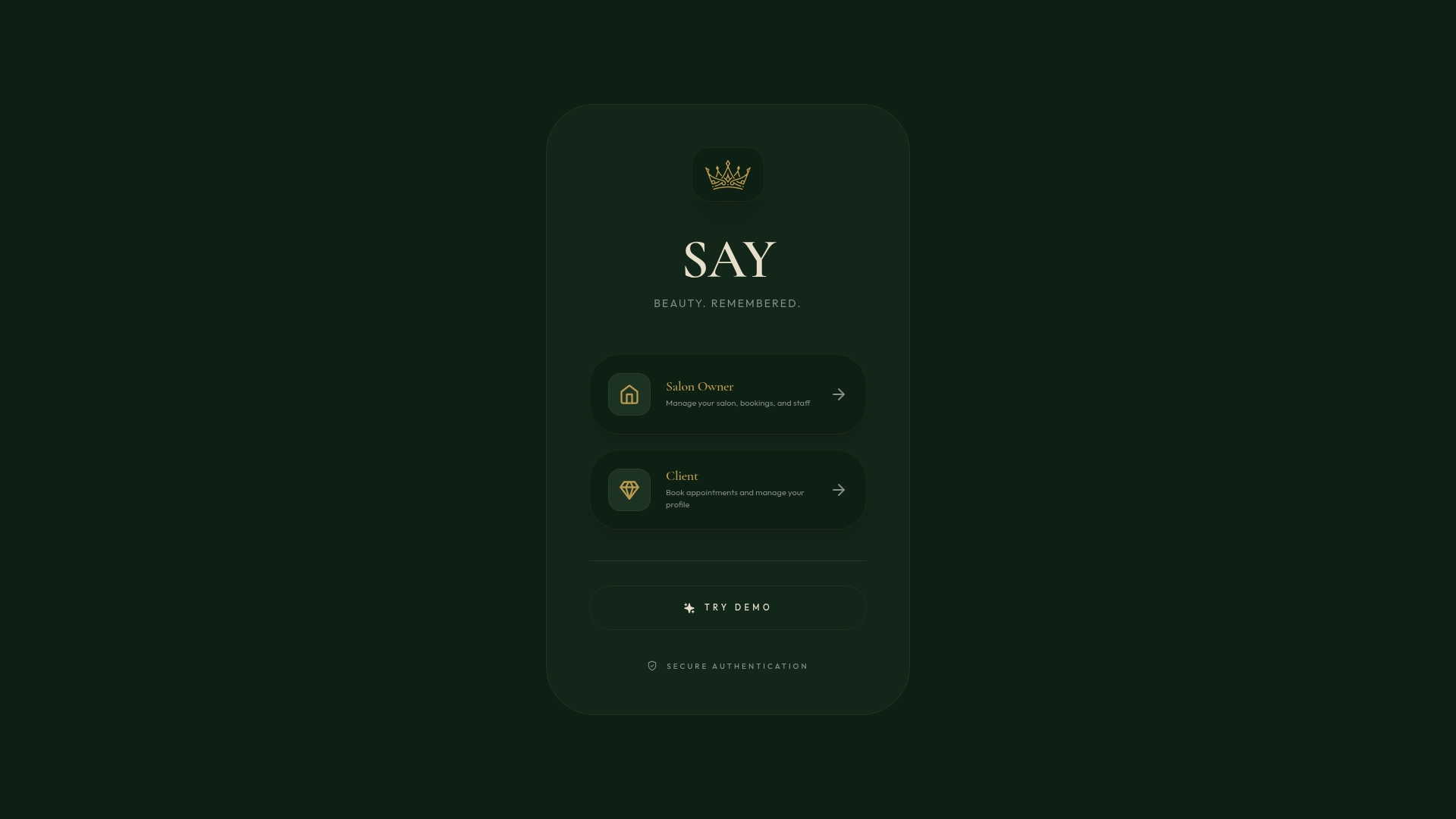
Say-salon's AI-powered platform, SAY-OS, handles bookings, client memory, and voice-first management so you can focus on the work that actually earns revenue. Clients get a free Beauty Passport that tracks their preferences and history, making every appointment feel personal without extra effort from you. For independent suite professionals who know that time spent on admin is time not spent behind the chair, that matters. Start free today and see how much simpler running your suite can be.
FAQ
What is the salon suite model?
The salon suite model lets beauty professionals rent a private studio space and operate as independent business owners, keeping all revenue after paying flat monthly rent instead of splitting commissions with a salon owner.
Why is the salon suite model growing so fast?
The salon suite industry grew at 10.5% annually between 2017 and 2022, driven by professionals seeking higher income, scheduling flexibility, and full creative control over their services and client relationships.
How much more can you earn in a salon suite?
Beauty professionals switching to suite rentals typically see a 25 to 35% increase in take-home pay within the first year by eliminating commission splits and keeping 100% of retail sales revenue.
What are the biggest challenges in running a salon suite?
Suite operators must manage their own bookings, marketing, supplies, and insurance. Underpricing services and inconsistent client volume are the most common reasons new suite professionals struggle to reach profitability.
How do salon suite franchises help independent professionals?
Franchise platforms cover utilities, provide technology tools, and offer education and community programs, giving independent professionals operational support while they retain full control over pricing, scheduling, and client relationships.